
The Road to Working Class Power: Permanent Revolution and the Proletarian State
A clear, accessible walkthrough of Marx, Engels, and Trotsky’s theory of permanent revolution, this piece explains why the working class must dismantle the capitalist state and build a new commune-state to achieve true emancipation and, ultimately, a classless society.
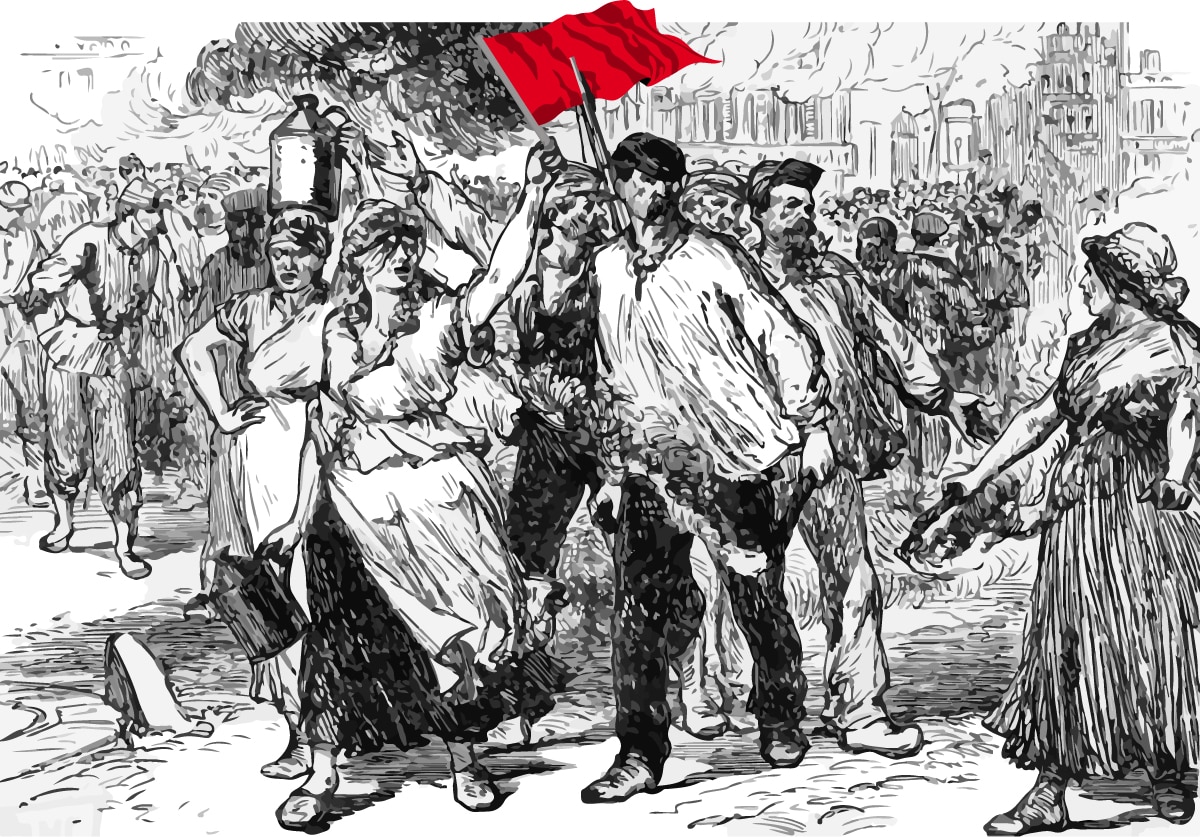
Illustration of the Paris Commune adapted from the century edition of Cassell’s History of England, (ca. 1900)
The Manifesto of the Communist Party is a basic and brief outline of the tasks of the communist movement. This program can be summed up in two words: permanent revolution. Permanent revolution is often associated with the Bolshevik revolutionary Leon Trotsky, but it did not, in fact, begin with him. Trotsky’s theory of permanent revolution is actually derived from Marx and Engels. In an address given on behalf of the central committee of the Communist League shortly after they completed the Manifesto, they say the following;
“While the democratic petty bourgeois want to bring the revolution to an end as quickly as possible, achieving at most the aims already mentioned, it is… our task to make the revolution permanent until all the more or less propertied classes have been driven from their ruling positions, until the proletariat has conquered state power and until the association of the proletarians has progressed sufficiently far – not only in one country but in all the leading countries of the world – that competition between the proletarians of these countries ceases and… the decisive forces of production are concentrated in the hands of the workers. Our concern cannot simply be to modify private property, but to abolish it, not to hush up class antagonisms but to abolish classes…” 1
This, in brief, is the theory of permanent revolution that was espoused by not only Marx and Engels, but also Lenin and Trotsky, and which was first elaborated in the Communist Manifesto. In the Manifesto, it is presented as follows: “The Communist Revolution is the most radical rupture with traditional property relations…the first step in the revolution by the working class, is to raise the proletariat to the position of ruling class… The proletariat will use its political supremacy to wrest… all capital from the bourgeoisie, to centralize all instruments of production in the hands of the state, i.e., of the proletariat organized as the ruling class…” 2
In other words, the working class must seize the state from the capitalists and use it for its own aims, to bring about a total transformation of society, and organize society around the needs of human beings rather than the needs of profit and finance. Once this has been completed, and class has been abolished, there will no longer be a need for a state, and it will, in the words of Friedrich Engels, “wither away.” This, however, is just the beginning of the theory of permanent revolution.
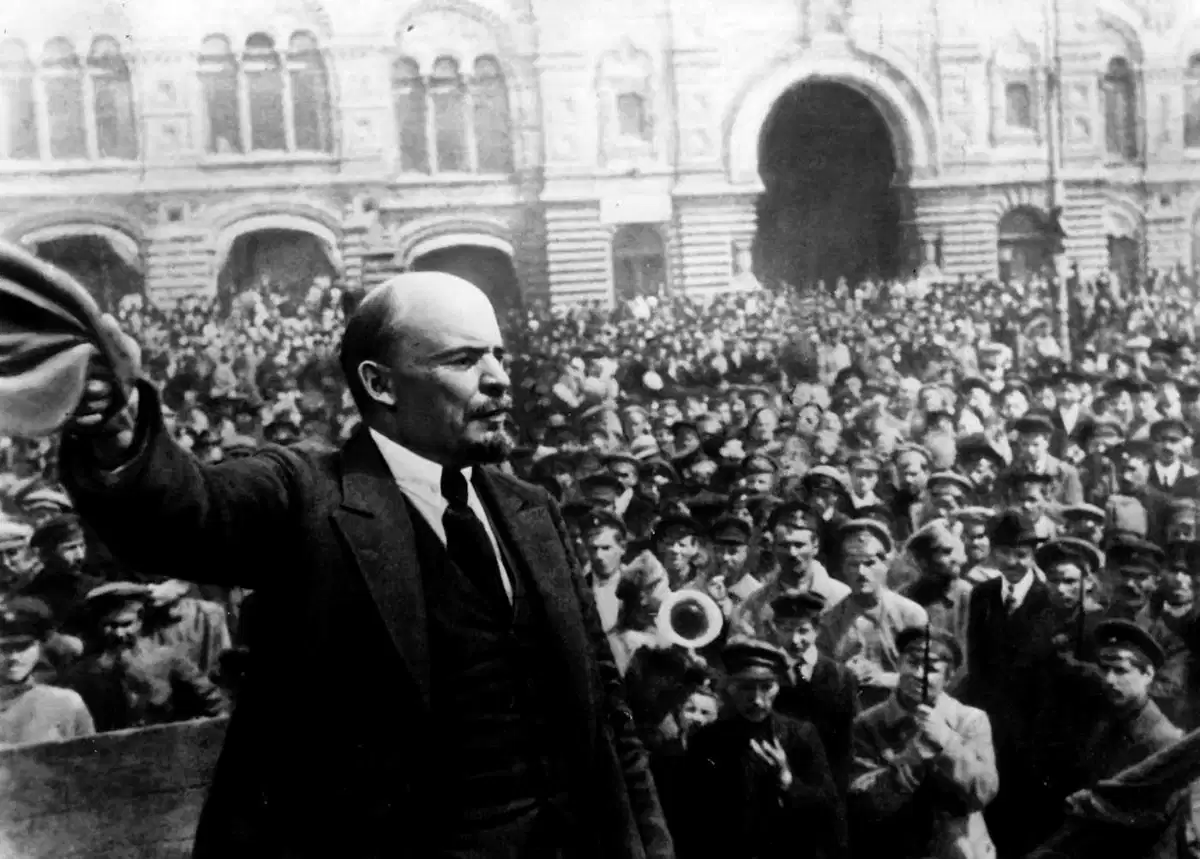 Vladimir Lenin addresses workers and soldiers in Red Square in 1919. Photo: Grigory Petrovich Goldstein, Red Square, Moscow, 1919. Public domain via Wikimedia Commons.
Permanent revolution in its final evolution recognizes a problem with the idea of “seizing the state” that some of you may have already noticed; why would a state, even a working-class state, willingly abolish itself? This is a criticism that has been brought up time and time again, and it deserves attention. The truth of the matter is that the state as we know it today is entirely the product of capitalism; the feudal kingdoms and slave empires of the past have very little in common with today’s administrative state, with its bloated bureaucracies and byzantine legal systems. This is because the needs of industrial and post-industrial societies are far more complex than the needs of medieval, feudal societies. States are not static; they constantly evolve, devolve, grow, and shrink based on the conditions in which they find themselves.
At this point, it might be helpful to bring forward two general tendencies that manifest across all different kinds of states. These are two conceptions of the state which are frequently pitted against each other in sociology and political science, but there is no reason for this to be the case. They are as follows: first, the state is a monopoly on violence and force. This idea, first put forward by the sociologist Max Weber, basically means that in almost all circumstances, the state is the only entity that is allowed to initiate violence, whether against individuals or organizations.
For example, I may suspect that my neighbor is carrying out illegal activities within his home, but this does not give me the legal authority to break down his door and hold him hostage. However, if I were to report my neighbor’s activity to the state, and they believed that there was sufficient evidence to justify such a forcible search of his home, then they would send in the police, who have the legal right to carry it out. On a material level, there is no real difference between me and some other residents of the neighborhood getting together to break down my neighbor’s door, and the police coming to do the same thing; they are the same act. The difference is that the police are representatives of the authority of the state, which is an entity that possesses, as said earlier, a monopoly on violence, a monopoly which is not held by me and the other residents of the neighborhood I live in.
With this idea of the monopoly on violence, Max Weber explains the basic element of the state, but he doesn’t say anything about who the state represents. This is where Marx and Engels offer some clarification; the current state is a tool of class rule. It is the means by which a class exerts its power over the rest of society. This is the second conception of the state: the state as an organ of class domination. Because each social class has a fundamentally unique historical task, their states inevitably end up being different from one another. A feudal state, as mentioned earlier, will not be the same as a capitalist state, and a workers’ state, sometimes called a workers’ republic, will be different–both in ends and means–from a capitalist state.
So, the capitalist state is designed with the specific needs of the capitalist class in mind. The primary need of a capitalist is, of course, profit; the capitalist state is thus built to ensure a more or less constant flow of commerce; it is tasked with maintaining conditions that are suitable for business. It is this state which Marx says must be “seized” by the working class.
But again, we come upon a problem; how can the socialist revolution use for its own purposes a state which was designed to serve the interests of the class that it is attempting to defeat? There is only one answer to this question: a socialist revolution cannot use such a state for its own purposes. This is not something that Marx and Engels make clear in the Manifesto, because they had not yet grasped it.
The workers’ state is not to be built on top of the already existing capitalist state. The capitalist state must be destroyed; this is the first task of the revolution. Then, a new state must be built. We must be cautious here; for revolutionary socialists, a new state is not the end goal; it is a means to the end, that end being the abolition of class. In other words, the state is a temporary tool that is used by the working class and its party to ensure its own survival and victory. It is a state which derives its impetus not from above, but from below. In 1923, a few years into the Russian Revolution, Trotsky said that “we cannot afford to wait for everything to happen from above, as a result of government initiative. The new social structure must proceed simultaneously on all sides. The proletarian state is the structural timber, not the structure itself. The importance of revolutionary government in a period of transition is immeasurable…” but this “does not mean that all the work of building will be performed by the state. The fetish of the state, even though it be a proletarian one, does not become us as Marxists” 3
I find the metaphor used by Trotsky to be a very useful one; the workers’ state is not the final structure, it is the framework that exists to guide the building of it. The building of this structure, the new social order, must be spearheaded by the masses themselves. Their state, the workers’ state, exists to support and guide them in the task of construction. The workers’ state exists to serve the working people; the working people do not exist to serve the workers’ state.
It is not until 1871, the year of the Paris Commune, that Marx and Engels would come to the crucial conclusion that I elaborated earlier; the state must not be seized by the workers, it must be smashed by them. Before we get into this, though, it would be helpful to give a bit of background information on what the Paris Commune was and why it proved so important not only to the development of Marxism, but the development of the whole socialist movement.
The Paris Commune was a short-lived socialist revolution that was brought about by the defeat of France at the hands of the Prussian Empire in 1871. In order to avoid capture by the advancing Prussian army, the French government abandoned the city of Paris and its residents. Rather than lie down and accept defeat, the workers of Paris, aided by the National Guard, which was itself mostly composed of workingmen, seized control of the city and established the Commune.
Immediately, elections were held, and representatives of the various socialist parties and workers’ organizations were thrust into power by the mandate of the people of Paris. They immediately declared the separation of church and state, extended the right to vote to women, established social management of workshops and factories, abolished child labor and night work, and implemented what we would today call rent control. Elected representatives were accountable to their constituents and liable to be recalled by them at any time, and the task of law enforcement was left to the National Guard, which consisted of the armed people.
In the two months in which the Communards held power, they gutted much of the old state apparatus, replacing it with new institutions that served the needs of the workers directly. They abolished the standing army as an institution separate from the rest of society, and in its place put the National Guard, which drew its numbers directly from the ranks of the working class, and which lived and fought alongside them; the salaries of the officials of the Commune were not to exceed the average salary of a worker, and officials were granted no privileges whatsoever over the rest of the population. Education was to be provided for free to all citizens, and so too would they be ensured stable employment. These are only a handful of measures instituted by the Commune.
The Paris Commune was virtually the first working-class state. It was a state of a totally different kind, so much so that the word “state” alone might not be sufficient to describe it. From the experience of the Commune, Marx concluded that “the working class cannot simply lay hold of the ready-made state machinery, and wield it for its own purposes.” No, that would not do. The old state machinery must be smashed to pieces, and that is exactly what the Communards did.
The entire working class administered the affairs of the Commune. No working person was excluded from it. It was the monopoly on force exercised by the proletariat against the capitalist class. This is the nature of a “workers’ state,” and any state that is not composed in such a way has no right to call itself working class, no matter how red its flag might be. Due to the nature of a workers’ state as fundamentally different from any other kind of state in history, I think it is appropriate that we modify the phrase. The socialist republic is not just a state; it is a commune-state; it is the state brought down to the level of society, united with it, ceasing to be alienated from it. There is no longer a distinction between the private sphere and the political sphere. The state becomes a weapon wielded by society to strike down those who rule over it.
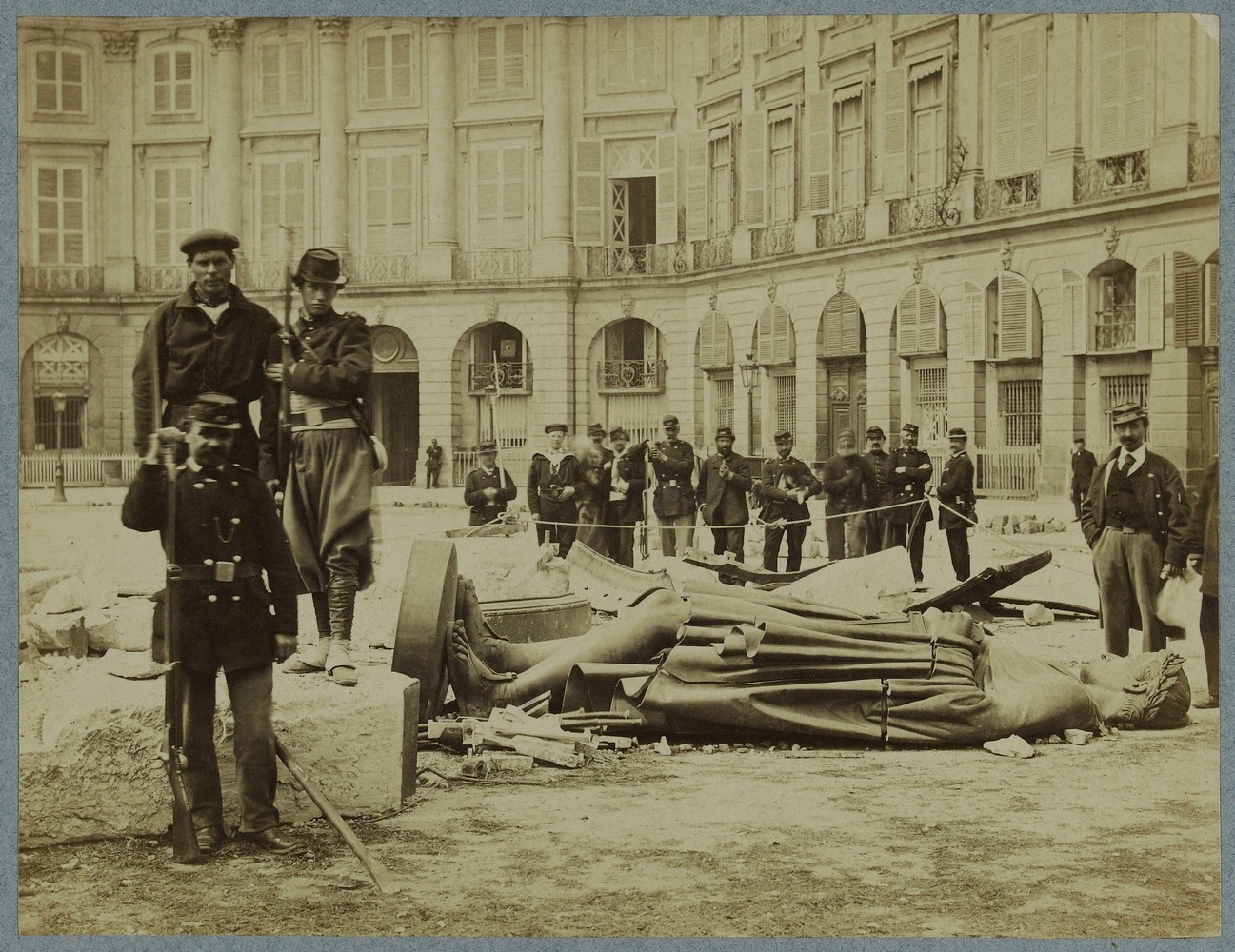
Workers and National Guardsmen stand among the remains of the demolished Vendôme Column. Photo: Bruno Braquehais, 1871. Public domain.
The commune is the means by which the working class, rifle in hand, suppresses the class of exploiters and modern slave drivers. By abolishing the capitalist class, it abolishes itself as an organ of the working class, for there can be no working class if there is no leisure class. Rather than being the burden of the exploited and the property of the exploiters, productive work becomes the common possession of all human beings. This is what Marx and Engels meant in the Manifesto when they say that public power loses its political character with the abolition of class; that there will be no more use for the apparatuses of violence and coercion, they will no longer be necessary or useful. The various roles of the state become superfluous and cease to exist.
Once the capitalist state has been dismantled by the socialist revolution, the task of building a new society falls to the working class and its party. This task has a dual nature; on the one hand, the revolution must lay the groundwork for a fair, equitable, and prosperous society in which individuals are free to actualize themselves and pursue their goals, and in which this activity harmonizes with the activity of other individuals and contributes to the prosperity of all. On the other hand, it must build structures and systems that deal with the more mundane elements of society, such as delivering mail and making sure that trains and buses run on time and in an orderly fashion.
These two goals, the humane and the practical, are two sides of the same coin; however, it must also be acknowledged that a tension exists between them. In any industrial society, even one that exists in conditions of post-scarcity, there has to be some kind of order; people can’t just do “whatever they want.” However, people must be allowed broad freedom to act the way they want to, and shouldn’t be placed under arbitrary and unfair limitations. Such an allowance for individual freedom will inevitably lead to some inefficiencies and waste, but this is a small price to pay. I, for one, would rather live in a world where people are free and equal, but where the mail is occasionally a few days late, than in a society where everyone is miserable and forced into conformity for the sake of efficiency and productivity. Besides, it’s not like our current government is all too good at maintaining public transport networks and delivering the mail on time.
I’d like to wrap up with an anecdote which very briefly demonstrates what is meant by the term “workers’ state”, at least when Marx and Engels used it. Karl Marx tended to get into very long and heated conflicts with his fellow socialists; he was a very combative man. One of these people was an anarchist by the name of Mikhail Bakunin, who was one of Marx’s lifelong political rivals. On one occasion, Bakunin, in an attempt to criticize Marx’s idea of the proletarian government, asked the following sarcastic question: “There are about forty million Germans; are all forty million going to be members of the German government?” To which Marx snapped back, “Certainly, because the whole thing starts with the self-government of the commune” 4
It is in this context, and this context only, that the state withering away can be taken seriously. The proletarian commune is, by its nature, nothing more than the entire working class organized against the capitalists. Every worker is a member of the workers’ state. Once the battle has been won and there are no more capitalists, there will also cease to be proletarians, for the existence of the working class is predicated on the existence of the capitalist class, and vice versa. With this, the class rule will end forever; the permanent revolution finally comes to an end. The governing principle of the World Socialist Republic will be each according to their ability, each according to their need, and the red flag will take its rightful place as the banner of a free and united human race.
- “Address of the Central Committee to the Communist League”, Karl Marx and Friedrich Engels
- Manifesto of the Communist Party, Karl Marx and Friedrich Engels
- Problems of Everyday Life, “How to Begin”, Leon Trotsky, pg 88-89
- “Conspectus of Bakunin’s Statism and Anarchy”, Karl Marx