
Organize the Ed School!: Building a Rank-and-File Pipeline at Brown
Last year, Brown YDSA launched a rank-and-file organizing workshop for current and future teachers. By focusing YDSA organizing on educators, the chapter puts the Rank-and-File Strategy into concrete practice.
Brown University YDSA’s workshop series, Rank-and-File Organizing for Teachers, is a new model of education and empowerment for teacher training that puts the rank-and-file strategy into action. Our program brings together student activists, Master of the Arts in Teaching (MAT) students, and current teachers from Massachusetts’ Educators for a Democratic Union (EDU) and Providence’s Caucus of Rank-and-File Educators (CORE). The EDU has led the Massachusetts Teachers Association for a decade while CORE launched recently. The series emphasizes militancy, democracy, and the power of the labor movement in education, aiming to transform consciousness and fight for the common good.
The past year at Brown demonstrated both strengths and weaknesses of high-intensity and media-covered action on campus. Rank-and-File Organizing for Teachers builds from a long-term organizing strategy for concrete power. The rank-and-file strategy mobilizes socialist organizers to join the labor movement in strategic sectors, such as education, healthcare, and logistics. These sectors already have relatively high union density and infrastructure and are uniquely situated within our communities and the economy to be able to powerfully intervene with effective strikes that can win broad working-class victories.
Kim Moody writes that socialists engaged directly on the “shop floor” hold the key for effective, radical unions and building a socialist society. As YDSA members, we can advance the labor movement through political education that connects young people’s existing career aspirations to organizing communities and socialist theory and practice.
At each convention since 2022, YDSA Convention has passed resolutions orienting our labor program to rank-and-file organizing, but chapters have struggled to directly implement this work. Additionally, socialist organizing at elite universities such as Brown can be frustrating because of the capitalist-class background or aspirations of some students. However, Brown’s education program, which offers a one-year MAT for students who have completed their BA’s or BS’s, is an excellent site for YDSA organizing. Our rank-and-file education organizing series recruits and activates lifelong labor organizers. We bring campus socialists and left activists into strategic industries, and we develop socialist consciousness among people already working in or training for those sectors.
We have a roadmap for other chapters to replicate and build on this work. (Email us at brown.risd.dsa@gmail.com!) Our workshop invites speakers who share their successes and challenges as teacher organizers, provide space for educators to reflect on the conditions in the schools where they are completing residencies or practicums, and dissect case studies that highlight teachers’ organizing wins. Student teachers’ direct experience of pervasive underfunding, systemic racism, and stagnancy in their residency schools illuminates the need for change but can feel demoralizing. Learning how teachers in Chicago, Los Angeles, West Virginia, and Massachusetts, have taken to the streets to win demands with and for their students and communities provides hope and a concrete path forward.
Our largest event of the semester brought Barbara Madeloni, a reform caucus leader whose insurgent election as president transformed the Massachusetts Teachers Association (MTA) in 2014, to campus. We approached a sympathetic professor in the education department who dedicated a full MAT class session to the visit. Organizers from across the Providence Public School District, members of undergraduate and staff campus labor organizations, and educators in Rhode Island DSA joined the session with over 100 total participants. Moz M., a workshop participant and Brown undergraduate who hopes to teach in New York City, shared, “hearing [Madeloni’s] practical experience of what that has looked like for her in being a part of the union and then rising up to be the president of the union […] was crazy,” and “I’d definitely say that is a highlight of this experience.”
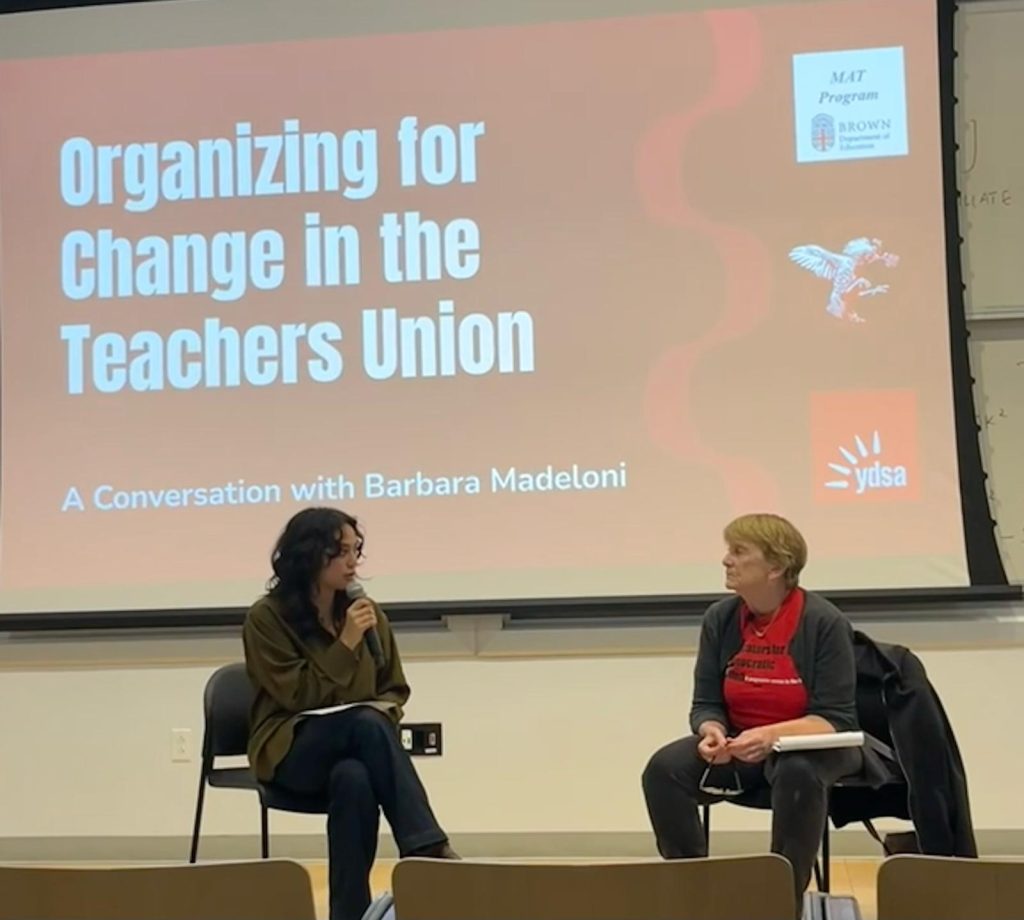
Gina in conversation with Former Massachusetts Teachers Association President Barbara Madeloni at an event hosted by Brown YDSA this fall.
Madeloni emphasized rank-and-file power, participatory democracy, and, above all, setting ambitious goals. Before the EDU surge under her leadership, the MTA, from the Administration to many front-line teachers, had a limited vision of what they could change about their working conditions. Previous MTA presidents prized their access to “The Governor,” won at the cost of silence in the face of anti-teacher and anti-student policies. Madeloni operated from the knowledge that politicians listen when workers are organized, not polite. She began her presidency with meetings across the state to engage rank-and-file educators. In these meetings, she posed three key questions: “What gives you joy in the classroom? What sucks the joy out of the classroom? And what’s one thing we could start to change that would bring the joy back?” Madeloni recounted a “heartbreaking moment” during one of these sessions when a teacher, responding to the final question, said, “Can we get some of those colored sticky notes that you’re using?” Madeloni reflected, “That’s how narrow their sense of what was possible had become.”
Within two years, the MTA made historic victories in anti-privatization and teacher protections. Madeloni led teachers in a statewide effort to fight a corporate-led and funded ballot referendum to expand charter schools and gut public-school financing. The victory of “No on 2” owed largely to immense rank-and-file teacher involvement—phone banking, canvassing, and simply speaking to members of their community. When ordinary teachers made their voices heard, ordinary voters trusted them: they struck down the referendum with 62% of the vote. It is clear that teachers are uniquely positioned to form broad coalitions with popular demands to win elections. However, their power is in the workplace, first and foremost. In fall 2024, three MTA locals launched wildcat strikes. Parents and students joined them on the picket lines, but they ultimately won bargaining concessions because of their labor power.
Madeloni’s hopeful messages reached and resonated with a new audience, including Anna R., a student in Brown’s teacher training program who had not been involved with YDSA prior to the talk. She shared, “I feel this sense of trust towards her [Madeloni] and, and here she is at this YDSA organized workshop talk and identifying with this group […] that’s kind of what I feel like draws me into spaces where I might not individually find myself.”
Our workshop series is only the beginning of a broader strategy and pipeline that our chapter will develop over the coming year. Our current workshops are limited by what we call “pre-organizing.” For the most part, we are training student teachers who will receive certification and enter the workplace within one to three years, and student teachers are excluded from union bargaining. More organizing may be needed to bridge the gap between training and the full workplace experience. However, Moz M. shared that the workshop was “something that I wouldn’t have even thought to seek out,” but that hearing “on-the-ground specifics of what organizing in unions look like […] before going into a union space” has been “crazy, crazy valuable.”
First on our priority list is encouraging rank-and-file graduates who stay in Providence to continue as workshop participants and leaders. Our workshop could take simultaneous roles as a workers’ circle-style organizing cohort for active rank-and-file teachers who bring in new generations of educators. We hope to expand relationships with current teachers in Providence CORE and Rhode Island DSA to integrate the workshops with solidarity work for current campaigns. We hope to integrate with the work of the Rank and File Project and local and national Y/DSA labor committees. Finally, we seek to support undergraduate, graduate, and staff unions on campus. This would bring undergraduate union leaders into rank-and-file labor organizing, turning teaching students and our workshop out for labor support, training, and actions led by unions on campus, and connecting organizing skills in active labor campaigns to long-term perspectives and strategies in the education labor movement.
YDSA must orient towards building lifelong socialist organizers within the rank-and-file of the labor movement. Because it integrates socialist ideals with concrete workplace practice, we see Rank and File as the strategy most likely to build lifelong and effective socialist commitment. Nursing and education—underpaid, overworked, and dedicated to the common good—are especially high priority. Organizing these sectors should begin on all of our campuses. YDSA can make socialist school-and-work connections between the colleges and universities already training many idealistic young people and nearby unionized employment. By concentrating YDSA organizing within strategic departments, we can build a denser base rooted in long-term strategy that can bolster democracy and power in labor unions toward mass action.