
For a Revolutionary Approach to Mutual Aid
A critique of contemporary mutual aid organizing, this piece argues that without a strategy for building working-class power and confronting the state, mutual aid risks becoming little more than a softer extension of capitalist charity. Using the example of Mesa County DSA, it calls for a shift toward campaigns that both meet immediate needs and mobilize people into sustained political struggle.
This article first appeared in the Winter 2026 Print Issue, which can be found here.
If you were to ask the average leftist organizer about the most important work that they are engaging in, chances are they will say something about mutual aid – that mutual aid work provides vital resources for the community, resources that just aren’t provided elsewhere. Things like free meals, contraceptives, and narcan. Mutual aid is different from charity because it is the community helping itself. Charity organizations are correctly identified as being paternalizing, disciplinary, and sometimes even punitive. Mutual aid, according to mutual aid organizers, is compassionate, accepting, and understanding. It doesn’t put up arbitrary barriers that prevent people from getting the help that they need.
This is all well and good. But what is it that actually, materially, distinguishes mutual aid from charity work? Beyond vague and sentimental phrases about community building and zero barriers aid, there really isn’t much that differentiates common mutual aid practices from charity. Both fill the same niche in the capitalist system; they administer and carry out services that the capitalists, for whatever reason, are not carrying out. In this way, mutual aid is not opposed to the capitalist economic system at all. Just like charity, it serves to blunt the edges of the worst failings of capitalism, and thus helps sustain it.
This is most exemplified by the mutual aid work of my local DSA chapter, Mesa County, Colorado. In the past year, Mesa County DSA has disproportionately focused on mutual aid work. This has mostly manifested itself as cooking warm meals for the Mesa county homeless population, which numbers in the thousands.
Have Mesa County DSA’s mutual aid efforts done anything to alleviate the plight of the homeless? Has it empowered the homeless to begin advocating for themselves as a part of the working class? It has not. The most it has done is temporarily fill the bellies of a few dozen people every month. It has, however, done nothing to alter the long term living conditions of said people.
In this way, the mutual aid work of Mesa County DSA is no different than the charity work of an organization like Catholic Outreach. We understand that this style of petty-bourgeois charity is shallow, as it seeks to only alleviate the symptoms of suffering without addressing or resolving its root cause. It totally fails to build the “dual power” system that Mesa County DSA claims to strive towards. If anything, it runs counter to this goal by actively propping up the local charity-industrial complex. Though the rhetoric of dual power seems radical, in reality, it is nothing more than a justification for abandoning the state as a terrain of class struggle; it encourages socialists to abandon the mass movement and retreat into isolated enclaves of “community building”. In effect, it serves to justify replicating the political practices of utopian socialists who want to retreat from society and its horrors to build a “better” society parallel to that which currently exists.
In the pursuit of building an alternative power structure, Mesa County DSA has abandoned any and all efforts to contest the one place where true power exists; the state. Mesa County DSA made no effort to prevent the shutdown of the city-funded Homewardbound homeless shelter and its associated services. Instead, they provide services of their own, recreating the structure of capitalist charity, the existence of which is used by the capitalists to justify such austerity measures! Mutual aid, when used by socialists to justify forsaking the struggle for state power, is nothing more than a total betrayal of the socialist movement.
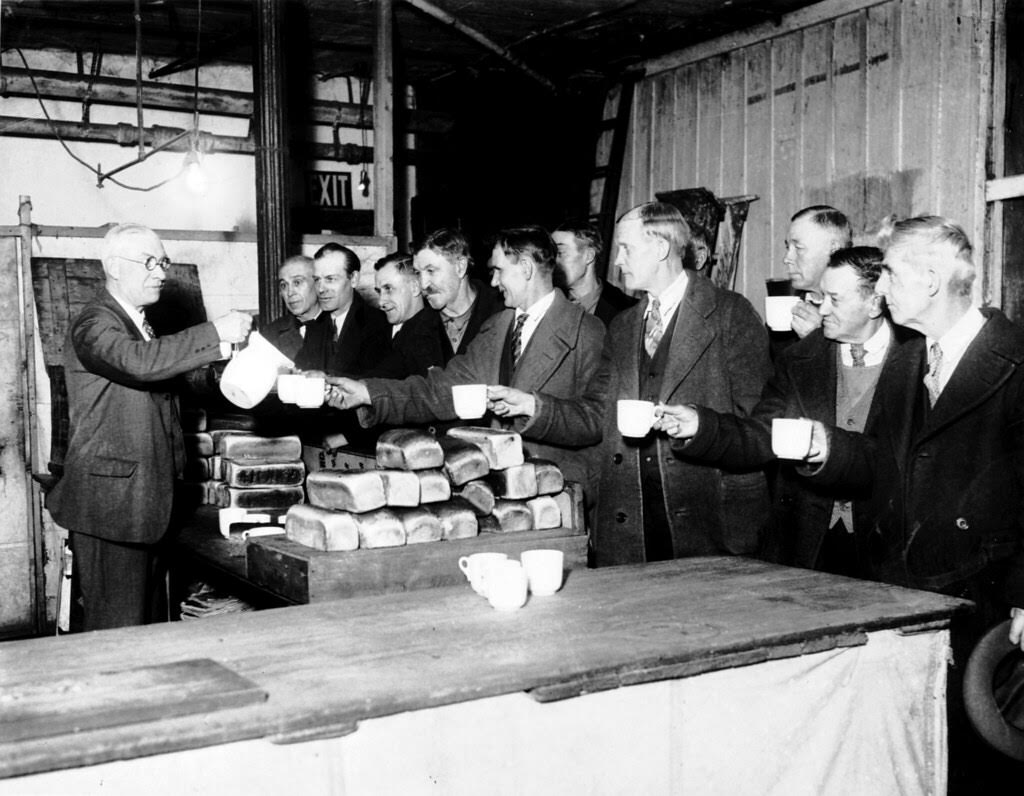
Men getting free coffee in a bread line. Credit: Kheel Center/Cornell University Library
What, then, would an effective and revolutionary approach to mutual aid actually look like? Let’s use the distribution of free Plan B as an example. Many YDSA chapters provide and distribute free plan B as a part of a campaign to pressure their university administrations to provide it to students for free. This way, the immediate needs of students are being met, and the failure of the university administration to care for its students is revealed for all to see. Specifically, the YDSA chapter at Florida International University distributed free plan B as a way to get people to sign on to their petition for the university administration to establish a free distribution system in a state that criminalizes abortion.
If Mesa County DSA wants to make their mutual aid work more effective, they should not abandon the struggle for city provided social services. They should carry out a pressure campaign against the city council and key supporters of its members to continue providing these services, while providing for the immediate needs of the people who are served by such programs. In a similar vein, if YDSA chapters want to make a real difference on their campuses, they should pair mutual aid work with mass campaigning to pressure university administrations to expand campus wide social safety networks. By organizing such long term campaigns, students and university staff can be brought directly into the struggle and developed into strong organizers and leaders. Additionally, such campaigns build resilient yet flexible organizations that are capable of mobilizing the masses to win the battle for socialism.
Mutual aid, in the way it is currently practiced by Mesa County DSA and much of the contemporary American left, has very little to do with the workers movement and the fight to transform society. It is, fundamentally, a utopian endeavor that seeks to lessen the contradictions within capitalist society by alleviating its worst injustices. This desire to alleviate the ills of capitalism while preserving the capitalist system itself is totally alien to the genuine socialist outlook. One can argue that it is still the moral and just thing to do; fair enough. However, the revolutionary struggle for socialism is not based upon a moral condemnation of capitalism, as useful as it may be for agitational purposes. It is, rather, based upon the material analysis of its contradictions and social irrationality.
Our work as socialists must identify and take advantage of the contradictions within the capitalist system, and must use these contradictions to show its untenable and unsustainable nature. Mutual aid goes beyond mere charity when it is used to both care for the needs of people and reveals the failures of the system. By doing this, we can pressure the state to do its job while also pushing for structural, non-reformist reforms that push capitalism to its breaking point.