
May 2028 Starts Now: Local Labor and Long-Term Strategy
NCC member David Lefevre urges YDSA to start organizing towards the May 2028 general strike led by some of the largest unions in the country. This work begins with measured goals and the expansion of YDSA alongside mass organizations.
As the rich race to become trillionaires, working people are deprived of healthcare, affordable housing, and free education. Capitalism not only makes the present miserable, but threatens the future of human life on earth with the risk of ecological collapse and nuclear winter. There is an immense gap between this status quo and our vision of an egalitarian world. It’s our duty to bridge this gap. While we hammer away on campaigns locally, it is often unclear how each of our isolated campaigns bring us closer to socialism. To seriously organize towards socialism we must connect our local campaigns to long, medium, and short term goals. Using this method, we can effectively organize towards a 2028 general strike that fundamentally alters the American political landscape.
YDSA is well positioned to lead a serious socialist movement in the United States given our ability to make tangible wins through struggle and our democratic national structure. YDSA chapters across the country have already fought and won campaigns to help unionize student workers, make Plan B affordable, create a sanctuary city for trans people, and elect cadre candidates to city council. Organizers of successful local campaigns mature our whole national organization by influencing national priorities made during the annual convention and share their experiential knowledge through national committees and in-person events.
Our national organization is also strengthened through the dialectics of having a big ideological tent. Rather than dissipating into sectarian groups, opposing factions transform each other and sharpen the politics of our whole organization by addressing internal contradictions. Grassroots organizing as well as local and national democracy allow our organization to synthesize solutions to internal contradictions and thus be well positioned to advance the socialist movement in the United States.
Connecting local campaigns and national strategy into a longer-term vision remains a challenge that must be overcome to seriously build towards socialism. This challenge is especially pertinent for YDSA, as high leadership and membership turnover can result in rapid fluctuation in national priorities. However, our national structure helps retain institutional memory around internal contradictions, as seen by previously contentious resolutions becoming hegemonic with supermajority convention approval.
New strategic questions should be raised within hegemonic resolutions, especially for some of our most important organizing tasks, to sharpen our national priorities. Resolutions can be improved by including ambitious multi-year SMART (specific, measurable, accurate, relevant, and time-specific) goals with annual milestones.
Some resolutions from the 2024 YDSA convention, such as the ones concerning labor (R3) and student unions (R21), have already moved in the right direction by setting multi-year timeframes. Resolutions with clear goals increase NCC and national committee accountability to our membership by creating clear metrics to track progress. Reflection on national priorities during annual conventions will allow for necessary adjustment to multi-year goals and prevent dogmatism. National priorities with ambitious multi-year SMART goals and annual milestones provide direction and support for chapters in long-term campaigns.
The two primary goals of DSA are to build a militant and organized working-class movement and to create an independent working-class political party. We should organize towards a 2028 general strike with the aim of building working-class political power in the 2028 presidential election year.
The goal for a 2028 general strike is qualitatively different from other disorganized, unserious calls for general strikes, since President of the United Auto Workers (UAW) Shawn Fain backed it. The UAW is well positioned to lead this charge as a multinational union representing several hundred thousand workers, which has recently organized multiple impressive strikes as well as new drives.
Furthermore, the American Federation of Teachers, which represents 1.8 million workers, as well as other union locals passed resolutions in 2024 to join the UAW’s efforts to build towards a 2028 general strike. The feasibility of these efforts are aided by increased working-class militancy, 26 million participants in the Black Lives Matter movement, and 3,645 arrests of students protesting for Palestine. This increased militancy must translate into a real, resurgent working-class movement which can reverse the half-century trend of declining union density.
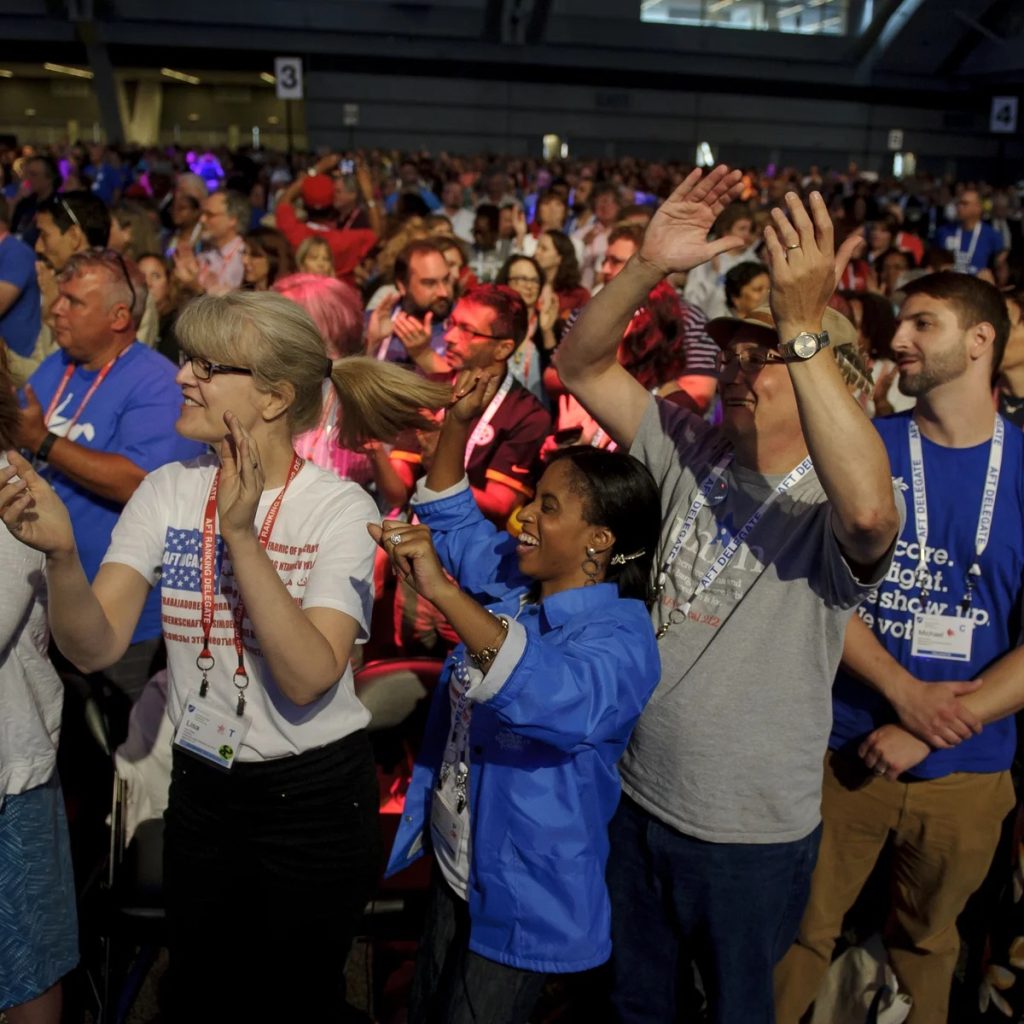
The American Federation of Teachers (AFT) 2024 convention voted to join the UAW’s calls for aligning contract expirations for May 2028.
An independent working-class party capable of supplanting the Democratic Party can only be achieved through renascent organized labor and social movements. Merging the economic and political struggle remains a central challenge of the socialist movement. In What is to Be Done, Lenin warns socialists of the danger of economism, as economic movements without aims for political power cede crucial terrain for class struggle, especially the ability to end imperialist wars which harm the working class at home and abroad. Political power is necessary for the working class to defend against the ascendent fascist attacks on undocumented immigrants, trans people, and people of color.
Many DSA electoralists conversely attempt to build a political movement without aims for economic power and thus cede the primary terrain for class struggle: the shop floor. Electoralists fail to build mass organizations around economic struggle which can additionally serve as a political base. The lack of an organized working-class political base can be seen by the swift defeats of Cori Bush and Jamaal Bowman against a well-funded AIPAC opposition campaign.
Both Jane McAlevey and William Z. Foster remind us that building an organized base of power in the community is a long process that can unify various social and economic groups. Only after many years of organizing did the mass mobilization of labor unions and sociocultural and religious institutions win major concessions in the United States, including New Deal social programs and civil rights protections. Y/DSA chapters must launch long-term campaigns of building strong mass organizations as a prerequisite for the formation of an independent working-class party.
To make these two intertwined goals SMART, YDSA must develop a long-term plan with milestones to ensure that these mass organizations are built. Ideally universities across the country would have a trifecta of student, student-worker, and tenants unions to leverage our economic power around tuition, labor, and rent respectively.
By coordinating strikes which could immobilize higher educational institutions with hundreds of billions in total annual operating budgets, this trifecta of unions could win major demands. There are a multitude of important spillover effects from student-worker unions: material wins for student workers, moving established unions they are affiliated with left, shifting consciousness of ordinary students who see their peers organize, training union organizers who are entering the workforce, and developing YDSA cadre. Furthermore, these mass organizations will radicalize a base of youth through struggle and be the proto formation for an independent working-class party.
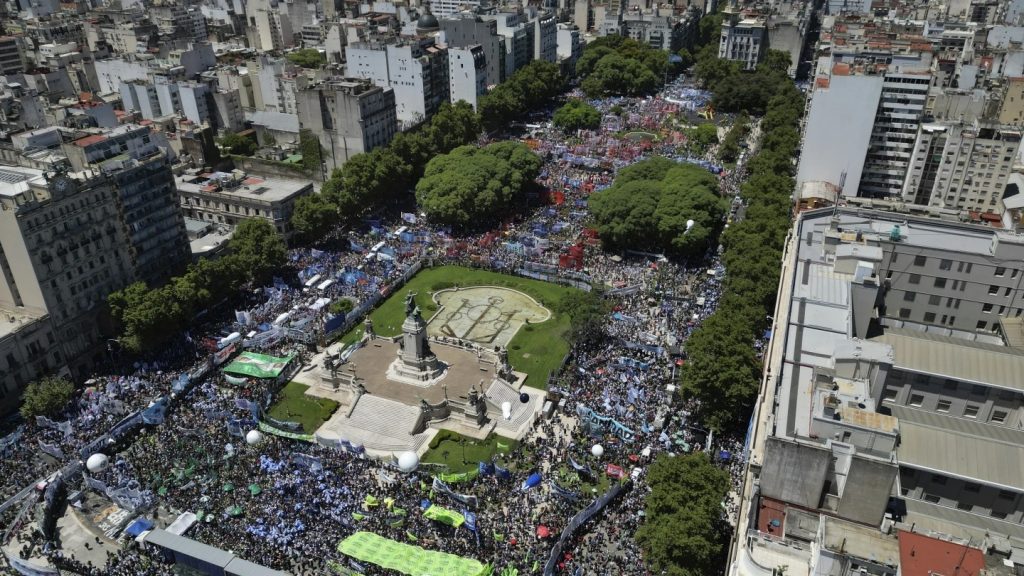
A general strike in Argentina in January 2024 protesting anti-labor decrees and austerity measures proposed by President Javier Milei.
No current organization other than YDSA has the infrastructure, organizational skills, discipline, and courage to begin building these mass organizations required to achieve our two principal tasks. But YDSA chapters must help build and exist alongside mass organizations, not dissolve into them. By being separate but deeply enmeshed in these mass organizations, YDSA chapters can serve as a vanguard element that advances the interests of working and oppressed people via class struggle.
YDSA chapters are not inherently a vanguard element and only become so through sacrifice and discipline of cadre organizers. Che Guevara reminds us that “the cadres, as political leaders, should gain the respect of the workers by their actions.” Being a vanguard is not a title that can be thrown around, but a relationship that is built through struggle. I have experienced this through my organizing at the University of Oregon, where our YDSA chapter founded the University of Oregon Student Workers United Auto Workers union (UOSW-UAW) and our organizations continue to have a symbiotic relationship with each other. In the early stages of UOSW-UAW’s creation, ideological commitment was a driving force of core organizers, which highlights the importance of YDSA chapters in the multi-year process of developing a mass organization.
Increasing YDSA chapter density and creating mass organizations is necessary to pull off a successful 2028 general strike that makes wins for working people and builds political power via an independent, working-class party.
I have set three milestones to work towards this ambitious long term goal. The first is to increase Pacific Northwest YDSA chapters density to four out of seven public universities in Oregon, two out of six in Washington, and two out of three public universities in Idaho. The second is for the Youth Labor Committee’s student worker mentorship to have three successful union drives and build ten new organizing committees (Reach out to the YLC for mentorship!) The third is to have an effective census of graduating YDSA members to track and improve our execution of the Rank-and-File Strategy, as well as funnel at least 150 graduates into DSA chapters.
Using these concrete milestones and strategies, we are well armed in the fight for socialism in our lifetime. We must be bold and dare struggle if we wish to realize our radical vision for a more just world.