
Marxism or Dogmatism?
Marxism is not a fixed doctrine, but an evolving method of analysis. This article argues that the socialist movement must reject dogmatism and hero worship, engage critically with ideas beyond the Marxist tradition, and embrace contradiction as a source of theoretical development. Only by remaining open to intellectual innovation can Marxism continue to grow and effectively confront the changing realities of capitalist society.
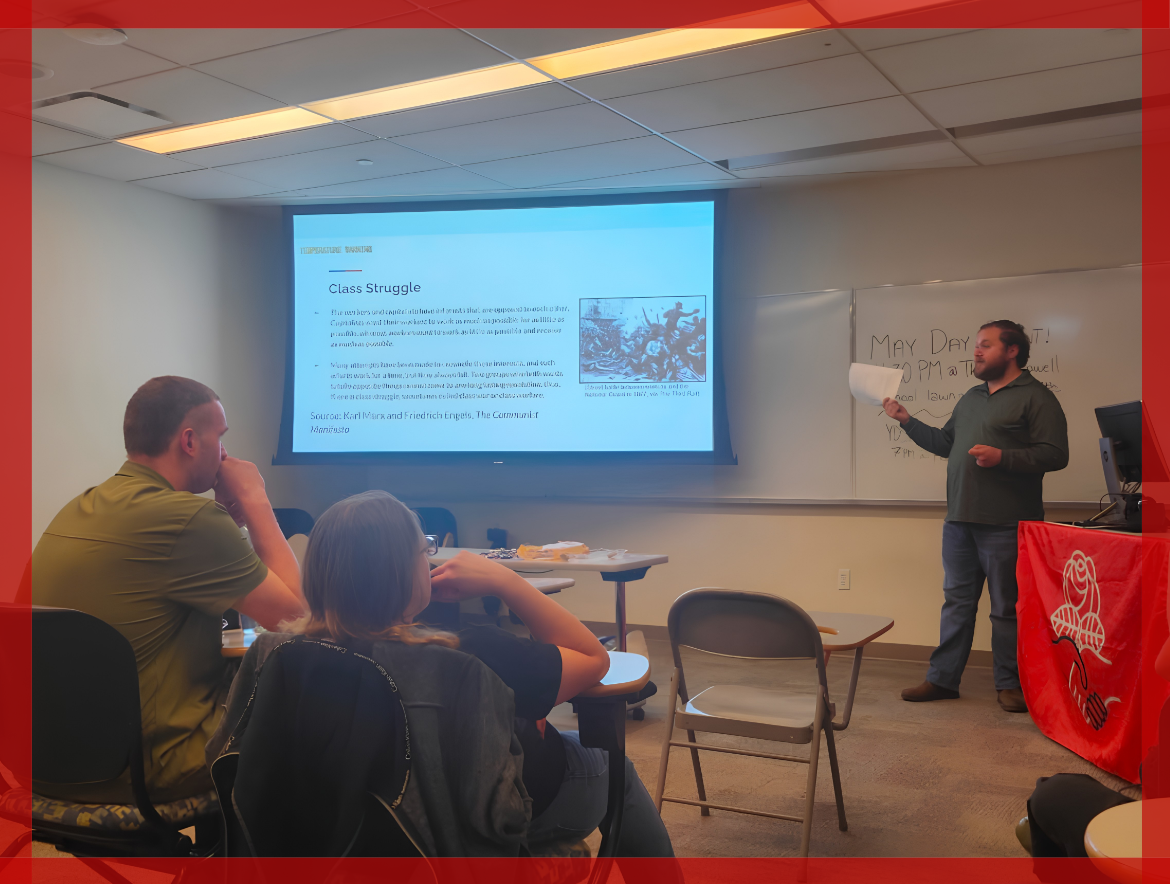
Nikoli Weir leading a political education discussion at Colorado Mesa University YDSA. Credit: Kaylee Mullen – CMU YDSA Co-Chair
Throughout history, the socialist movement in the popular consciousness has overwhelmingly been defined and led by a small handful of key figures; people like Marx, Engels, Lenin, Trotsky, and Mao. These people, in the liberal imagination, have been the lone arbiters of socialism, tailed by the adoring and unthinking masses. This is nonsense. The socialist movement is and has been composed by hundreds of millions of people from all ranks of life, from the upper layers of society to the lowest sections of the working class. There is, however, a grain of truth to this sentiment, and that grain of truth is this; amongst Marxists of all stripes, there is a strong trend of hero worship based on the grounds that this or that leader developed the one absolutely applicable truth that all must follow.
Oftentimes the figures subject to hero worship did do incredible work to advance the socialist cause, and some of them were first rate theoreticians. However, regardless of the theoretical prowess of any given leader, it must always be remembered that there is no absolutely true method or approach to socialist revolution and transition; there are certainly approaches that are incorrect, the most glaringly obvious being those that ignore class struggle and place cultural struggle at the core of their analysis (as is often done by fascists and liberals alike), and there are certainly approaches that have some degree of universal validity. However, to claim that the particular truth content of any given framework or ideology is absolutely true regardless of different conditions or special circumstances is the height of folly.
Unfortunately, this is a folly that many Marxists have fallen prey to. Leaders are put on pedestals, idolized as great men who are infallible, and their slogans, ideas and strategies are repeated ad nauseum, forced onto greatly varying situations in a uniform and undiscriminating way. Not only that, but the dogmatic reliance on the utterances of the founders and leaders of movements is often at odds with what those leaders themselves advocated for.
This is because the leaders of the socialist movement do not just offer strategic or tactical guidance; they perform another invaluable service; they are the medium through which the socialist movement assimilates the best work of the intelligentsia. There is a sentiment among many Marxists that the ideas of modern philosophy, if they fall outside of Marxism, are worthless, and that nothing good ever comes from taking those ideas for ourselves and using them for our own purpose. Not only is this dogmatic and undialectical, it is also ahistorical. The ideas of the most advanced and aware section of the intelligentsia have always, since the days of Marx and Engels, served as fuel for the movement. The ideas of Marx and Engels or Lenin and Trotsky did not come out of thin air; they emerged after a long and detailed engagement with the ideas of the non-revolutionary intellectuals.
The greatest example of this is Marx and Engels demystification of the ideas of Hegel. In the postface to the second edition of Capital, Marx has this to say about the influence of Hegel’s ideas on his work;
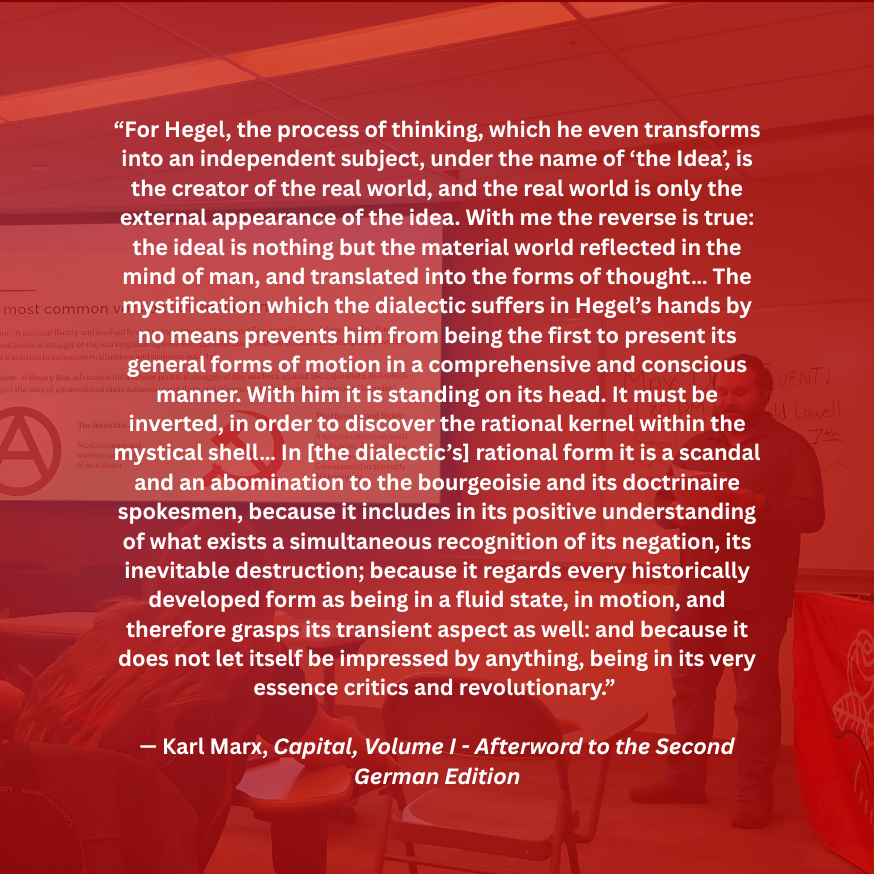
Nikoli Weir leading a political education discussion at Colorado Mesa University YDSA. Credit: Kaylee Mullen – CMU YDSA Co-Chair
Though Marx made key revisions to Hegel’s dialectical ontology, he did not create it wholesale from his own mind. The parts of this idea, dialectical materialism, were already present in Hegel’s absolute idealism. This is not just the case for it alone, but for all ideas. No idea exists in isolation; ideas form and develop by branching off from other ideas, by borrowing from them key concepts, axioms and definitions. The only way to create new ideas is by looking into the ideas that came before, rearranging, reinterpreting, and reordering their constituent parts, and extrapolating new parts from already existing ideas.
Naturally, dialectics is not the only example of this. Socialists are and have always borrowed the ideas of the intellectuals and adapted them for their own purposes, and there is no reason why this should stop now. In order to continue the development of Marxism,we must employ the Marxist method to the analysis and utilization of whatever concepts, ideas and strategies serve our ultimate end, which is the overthrow of the capitalist order and the building of a proletarian republic.
I maintain that much of the current crisis in Marxism emerges from this refusal to engage with any idea that emerges from somewhere other than Marxism itself. We have become so sure of ourselves that we have made the grave error of excluding all contradiction from our thought, despite the fact that the universality of contradiction is one of the pillars of Marxist philosophy. Nothing has ever died of its contradictions. Contradiction is the universal motor that drives the whole world and everything in it. Any attempt to block it out will at best fail, and will at worst lead to stagnation, decay, and eventual death.
Marxism can only be strengthened by encounters with ideas that contradict it, in whole or in part. Without this, the theory, which by all accounts is a living, growing and changing theory, will cease to live, grow and change. Not only the development of the modern socialist movement, but the whole history of Marxism, confirms this.
This is not to say that all ideas are worthwhile just because they offer a contradiction to Marxism. Most ideas of this nature are the opposite of worthwhile; they are a waste of time. But the only way to really know that is by being open to engaging with them, criticizing them, and potentially incorporating their criticism of Marxism into Marxism itself. If Marxism is to be revitalized, it must cease to be a closed system. Any system that closes itself off from the endless transformations of the world both physical and intellectual is a system that denies itself the ability to grasp the world in all its nuances and potentialities.
To overcome this crisis, the leaders of the socialist movement must encourage two things. First, they must, by means of reading and discussion groups, theoretical publications, and prolific popularization of Marxism, cement the ideas and methods of Marxism firmly in the minds of the rank and file membership. Once completed, an organized push to systematically understand and criticize the works of theoreticians who may or may not align themselves with the Marxist left will lay the foundation for the largest, most democratic and mass oriented discussion of theory in history.
This discussion will raise the intellectual level of the socialist movement to newer heights, not only including the intellectuals and leaders of the movement, but every member. In one fell swoop, consciousness will be raised, new leaders will emerge, and the organization itself will experience leaps and bounds in the quality of its membership. Out of this will emerge the most comprehensive, radical and inspiring vision for the future since the beginning of the Russian Revolution.
It should go without saying that this approach cannot be successful in isolation. It requires the pre-existence of a large, semi mass socialist party or organization which is able to act as an impetus for it. It requires that the working class already be in more or less open conflict with the capitalist class; it requires the existence of local movements that are nationally coordinated. All of these things exist in the United States, and they are becoming more prominent everyday. Civil society and the working class behind it is now mobilizing against the capitalist class. While we prepare the ground politically and organizationally, we must also prepare the ground intellectually. The ruling ideas of any epoch are always the ideas of its ruling class, and these ideas must not remain systematically unchallenged if the socialist movement is to achieve long lasting and sustainable victories.

Soviet propaganda poster, “Africa Fights, Africa Will Win!”, depicting a Black man breaking his shackles, symbolizing African anti-colonial liberation movements. Credit: Viktor Koretsky