There’s Power in the Union: Democracy and Divestment at SFSU
After a 16-day encampment last spring, San Francisco State University students won full divestment from weapon manufacturers. Ali N. argues that their power was rooted in the union’s democracy and transparency.
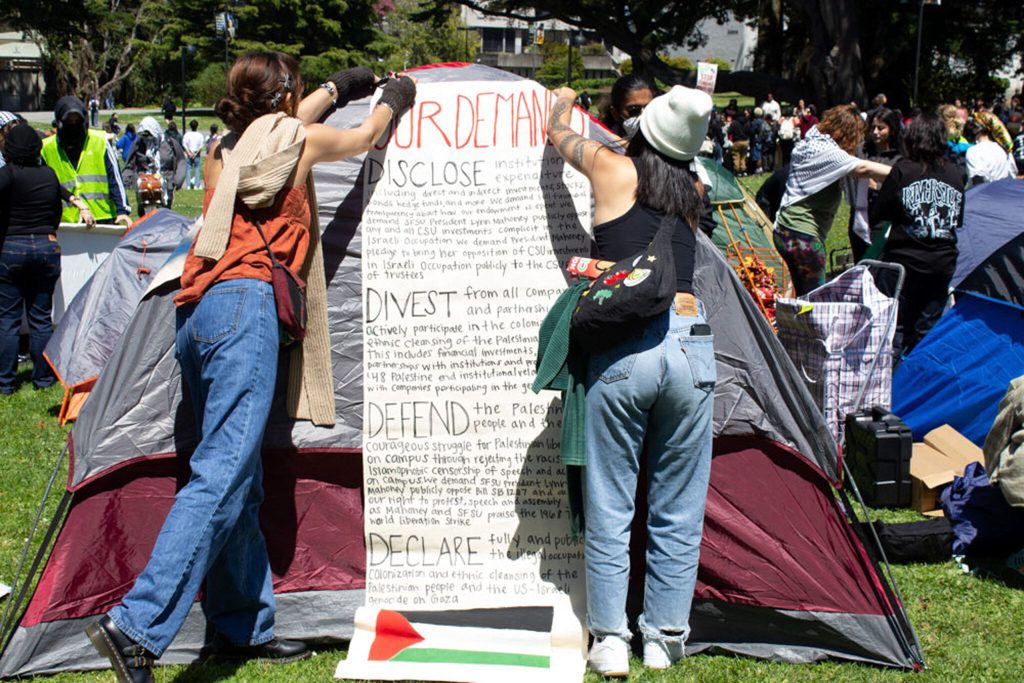
In Fall 2024, San Francisco State University became the first university in the United States to entirely divest from weapons manufacturing companies. The university did so on the back of a 16-day long encampment that forced our university leaders to make concessions. But, understanding the win through those 16 days alone reflects only a surface-level analysis.
Months before the encampment started, SFSU was in turmoil. California State University leaders had voted to raise our tuition by 35% over five years. Hundreds of faculty had been cut in the spring semester due to budget cuts. The anger these cuts had provoked sparked an incredible wave of student organizing in the fall of 2023. I watched as several hundred students marched throughout campus demanding a reversal of the tuition hikes. Our faculty went on a system-wide strike, grinding university operations to a halt for parts of December and January.
Through these experiences, SFSU organizers came to understand the issue at the heart of these struggles. At SFSU, there’s a sense of isolation that pervades every classroom. It’s a working-class school where most students are burdened by long commute times and working one or two jobs on top of full-time classes. Most commuters are eager to leave as soon as they enter campus, leading to a lot of students who seem too tired (or too anxious) to build relationships beyond their studies. In the classroom, you can almost feel a vow of silence among the majority of students. There is little sense that one student belongs to a larger student body.
The consequences of this isolation culture are huge for our organizing. In one class I presented to in the fall, I asked the question, “What would it take to reverse the tuition hikes?” A student raised their hand to suggest a student strike. Many of their classmates expressed agreement. Next, I asked, “If a student organization called a strike tomorrow, but you didn’t know if your classmates would strike with you: would you strike?” Only one student raised their hand, and it wasn’t the one who suggested the idea.
Students are upset about countless issues. But, they feel powerless to stop them. They feel powerless because they don’t have confidence that if they fight, their classmates will fight with them. At SFSU, we as socialist organizers had to build an organization whose sole purpose was to break through that false sense of powerlessness. We envisioned a scenario where one student could look at a crowd of other students holding their hands up for a strike, and know that they weren’t alone. YDSA was great, but it was limited to socialists. We needed an organization that could represent the entire student body. So, to address this issue, we started building the Student Union.
Our vision of the Student Union was somewhat general at first. We knew we wanted an organization that, 1) attracted membership from all over the university, 2) fought around the issues that impacted the widest breadth of students, 3) was steered by rank-and-file students, and 4) was dedicated solely to building the power of the student body.
Early on, we made a conscious decision that we would build something different than the coalition model (meaning a coalition of organization leaders that get together to coordinate a movement). The main challenges that come with the coalition model are twofold. One, more time is spent wrangling activist leaders than on organizing the students we need to organize. When you’re stuck in several meetings a week trying to corral other activists, there’s little energy left to go out and organize your classmates. This makes organizers feel as if our power lies in our relationships with other activist leaders. But in reality, our power lies in the hands of the student body – and whether or not we can move them to fight together. Two, control of the movement is taken out of the hands of ordinary students. These coalitions inevitably come with the expectation that decisions are made behind closed doors by activist leaders, rather than out in the open. At SFSU, we wanted more students to take ownership of the movement against the tuition hikes. So, we abandoned the coalition model. Instead, we sought out to build a mass organization that could represent any and all students. As later events showed, this decision was crucial to our divestment win.
By the time of the encampment movement, we had been building our Student Union for about six months. The Union had accrued about 40 active members and 500 paper members from across the school. Our work consisted of three organizing priorities: One, winning the trust of people in our classes; two, agitating them around campus issues; three, training new organizers that could do the same.
A lot of the initial classroom-level organizing was constant trial-and-error. I lost count of the students I did 1-on-1s with once just to never hear from again. But, when we failed, we failed in ways that allowed us to learn. Throughout these months, we developed a small group of organizers that were steadily learning how to do this kind of organizing. These same organizers would later make the interventions that allowed the encampment to succeed.
Our first organizing took place around non-Palestine issues, yet it ended up serving as crucial to the encampment moment. Following the events at Columbia, the Student Union called for a general assembly of the student body to vote on whether to hold an encampment on our campus. Initially, there was deep hesitance from other student organizations. Most activist leaders approached the idea of an encampment with sentiments ranging from unease to outright hostility. Our response to this was to invite everyone, opposed and supportive, to come to the general assembly and express their opinion.
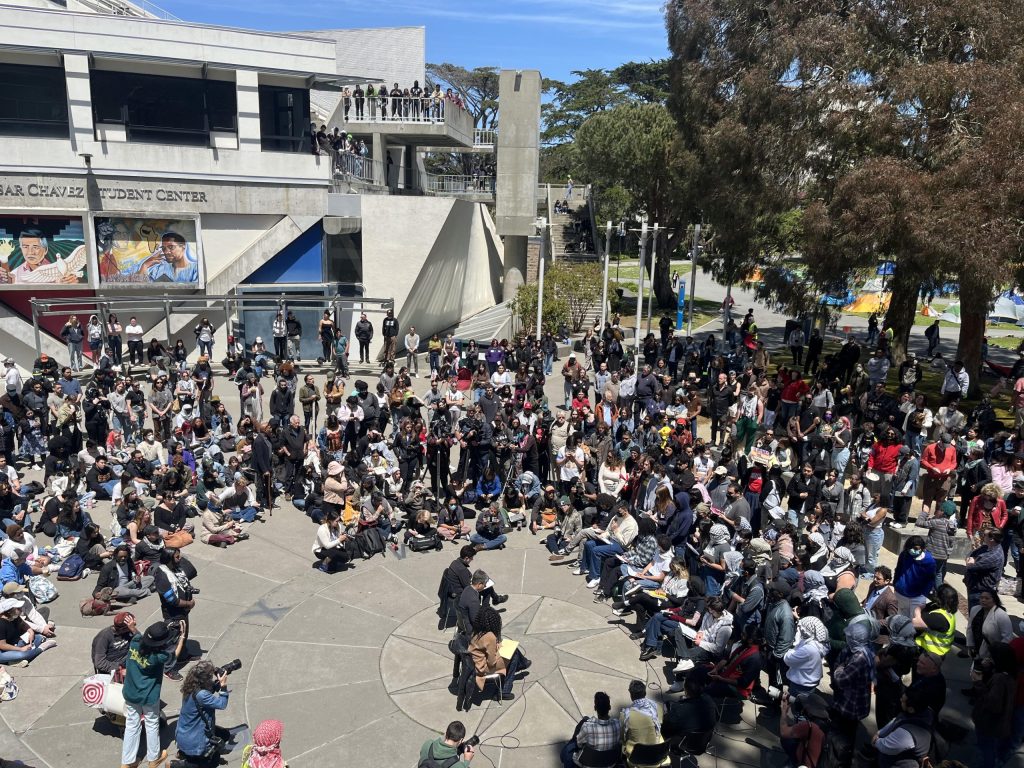
The general assembly proved pivotal. About 170 students showed up to take part in the debate. Most of these students had been turned out by Student Union organizers in one way or another. Some leaders really let us have it with their opposition to the encampment proposal. Nevertheless, in the end, the encampment vote passed with about a two-thirds majority. For months, we had been building up the muscle of the student body for one fight around the tuition hikes. What we realized was that the strength we had built up in one struggle was not restricted to that one struggle. That same muscle was ready to take on the fight for justice in Palestine when the moment came.
Once our encampment began, we were uncompromising on our principles of democracy and mass organizing. After the assembly vote, a few leaders expressed reservations on the possibility of setting up a democratic encampment. Instead, they suggested an appointed leadership of the “most advanced” activist leaders to better serve the encampment. However, given that the majority of the relationships with prospective campers had been developed by Student Union organizers, we were able to set up the encampment in the democratic model of the union. On the third day of the encampment, a leadership body was democratically elected by a general assembly. Four of the nine leaders, including me, were leaders from the Student Union. On the fourth day of the encampment, campers voted 70-1 to mandate open bargaining with the president of our university, Lynn Mahoney. By the seventh day, SFSU became the first encampment in the country to openly negotiate with a university president in the middle of campus in front of 400 students, faculty, and community members.
Following the first bargaining session, President Mahoney deferred the responsibility of changing investment policy to others. She placed responsibility on the Investment Committee, the SFSU Foundation, and Jeff from Cambridge (an unknown man that she referenced at least ten times during the first bargaining session). Deflections were expected. So, as encampment leaders, we printed out her email response, recited it word-by-word to the encampment, and posted it to social media.
Later, the encampment voted on escalatory tactics at a general assembly: picketing the administration’s parking garage and holding a march and die-in around the administration building. The march rapidly grew to almost 1,000 students. Following this march, we received another email response from Mahoney. SFSU was willing to commit to divesting from weapons manufacturing companies by the Fall 2025 semester, among other concessions. After weeks of camping (and months of organization-building), the encampment finally had won material change from the administration. We brought the deal back to our general assembly, which approved the agreement and voted to decamp.
After the agreement, we held a rally to celebrate our wins. I marched alongside hundreds of students whose first real political experience was in this struggle. I remember vividly a conversation with one student in particular. I hadn’t seen him before, and I struck up a conversation with him while we moved with the larger crowd. I asked him why he came to the rally, and he answered that this was actually his first. He hadn’t come to any of the prior protests. He didn’t feel they would make much of a difference. I asked him, “What changed?” He responded that he saw that we actually won something.
As that student enters the rest of his life, like hundreds of others at SFSU, he will take the experience of this movement with him. He will carry the understanding that you can actually get shit done by fighting together. He will not go into the workplace with the bitter self-defeating cynicism that dominates so many others. Our task as socialists must be to replicate his experience all around the world.