
Towards a Nationwide Student Union
To carry out student strikes, we’ll need militant and democratic student unions. But we can’t stop at one campus—it’s time to start thinking about a nationwide student organization.
Today, the landscape of left student politics is defined by three forces—young socialists, the student labor movement, and the movement in solidarity with Palestine.
Student workers have organized to build power in the workplace. Solidarity activists have pushed the burning question of Palestine onto the political agenda. Student socialists have worked to build both movements and draw connections to the struggle against capitalism.
But despite our real successes over the last few years, the majority of students on our campuses remain on the sidelines. And the crises of austerity, fascism, and climate breakdown only grow more threatening.
To break the impasse, young socialists need to find a way to mobilize masses of ordinary students. At universities like San Francisco State, City University of New York, and Virginia Tech, YDSA members are experimenting with a new kind of organization: a membership-based student union.
Militant and democratic student unions like those in Canada and Brazil organize students across academic departments and use the threat of strikes to bring administrators to the bargaining table.
Last summer, YDSA convention delegates passed a resolution committing our organization to identify and support five campuses with the potential to establish student unions over the next three years.
Student unions are still in their infancy, and building them up will take time. But given the urgency of fighting back against an ascendant Right that wants to smash Palestine solidarity and gut public universities, socialists need to start thinking about the bigger picture.
How can we link isolated student struggles together into a nationwide movement stronger than the sum of its parts? And how can we make student power a real and durable factor in state and national politics?
Campus student unions are a necessary starting point. But to realize their full potential, student unions need to be constructed with something much larger in mind: a nationwide, membership-based student association.
Three developments in the student movement
Since the pandemic and over the course of the Biden administration, three major developments occurred in the student movement. The first was the growth of YDSA and other student socialist groups, even in a period where DSA and progressive-left organizations struggled to grow.
The second was the emergence of undergraduate student-worker unions, a type of organization with almost no precedent in the United States or abroad. Today, there are at least 34 different majority-undergraduate worker unions around the country, representing over 32,000 student workers.
The third development was the dramatic emergence of the Palestine solidarity movement on campuses around the country since October 2023. YDSA chapters have played an important role in both student labor and Palestine solidarity organizing.
Taken together, these three currents—socialism, undergraduate worker unions, and Palestine activism—are a major step forward for the student movement.
But this picture is missing something. We know that not all students are ready to join YDSA chapters. And while young people are broadly horrified by the Gaza genocide, the number of students willing to take action and join Palestine-focused issue organizations like Students for Justice in Palestine (SJP) is still small.
Undergraduate student-worker unions are different. Labor unions engage working people at an immediate level, meeting them where they’re at by fighting for improvements to their working conditions. But student labor unions have an obvious limitation: they only organize the limited number of students who have jobs on campus.
Many working-class students aren’t employed by their universities, and either work off-campus or take out student loans. Even students who do have campus jobs still have basic needs that can’t be addressed easily through labor-based collective bargaining—issues like affordable housing and funding for academic programs.
If we want to transform our universities to win our biggest demands, we’ll need to mobilize huge numbers of students. That will require another kind of organization—one that takes advantage of the latent power held by all students on our campuses.
Student unions: the missing piece
Labor unions are at the heart of the socialist strategy for building working-class power because they are structure-based organizations. Unions bring very different people together by virtue of their common position in a social structure—a workplace.
How can we get students to fight for their common interests when they’re not all employed in campus jobs? The key is to understand the university itself as a kind of social structure analogous to a workplace.
Students have particular collective interests and experiences just by virtue of being students. These interests are powerfully shaped by a common institution, the university, and the administrators who control it.
Administrators depend on the daily labor of students to keep the university running. This is obviously true of student workers in dining halls or dorms. But it is also true of students’ academic lives — going to classes, submitting papers, and taking exams.
The reproduction of the life of any college campus is premised on this daily activity, which is a kind of labor. And like all labor, it can be withdrawn.
These structural conditions make possible a kind of organization that is historically rare in the United States, but fairly common elsewhere around the world: the student union.
Student unions mobilize students by engaging them around issues which affect a majority of all students. To achieve their goals, student unions can leverage students’ labor-power by going on strike and forcing university bosses to the bargaining table.
This spring, we’ll see which YDSA chapters around the country are capable of organizing student strikes for Palestine, free speech, and possibly broader economic demands.
To pull off a student strike, YDSA chapters and allied organizations will need to build academic organizing committees, call mass meetings, and run strike authorization votes. If the strikes succeed, these organizing structures can and should become a foundation for launching student unions as permanent organizations.
Taking it nationwide
Student unions fill a gap in the political infrastructure of individual campuses. But the absence of a mass student organization is a problem felt at the national level, too.
Republicans and Democrats feel free to cut funding to higher education, carry out witch hunts against pro-Palestine organizations, and pass laws that hurt young workers because they know that student resistance is sporadic, disorganized, and immature—when it happens at all.
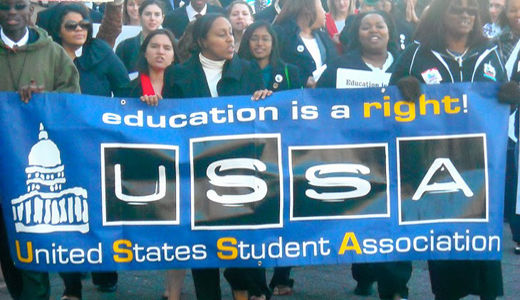
Students haven’t always lacked national representation. From 1978 through the 2000s, the United States Student Association lobbied at state and federal levels on behalf of students and, in its heyday, supported important campaigns like Students Against Sweatshops. But in 2017, USSA failed to elect a new leadership and became defunct.
Students of San Francisco State University set up one of more than 20 tents on the campus quad on Monday afternoon. SFSU is one of the latest universities to join the student-driven protests popping up across the country in support of Palestinians in Gaza and the divestment of university funds from companies with ties to Israel. San Francisco, Calif. April 29, 2024 (Kyra Young/for The Guardsman)
The key weakness of USSA was its membership structure. The association claimed an enormous membership of one million students, but this was only because of its composite structure as a federation of student governments. These student governments would affiliate with USSA and funnel some of their student fees upwards to the association.
USSA’s “membership” comprised all of these fee-paying students, few of whom had likely even heard of USSA. Without an actively-engaged membership and dependent on student governments that were themselves subject to policies dictated by state governments, USSA was vulnerable to Republican backlash. In the mid-2010s, it ran out of money and succumbed to infighting.
If we’re going to rebuild a nationwide student association, it must be built on a foundation of fighting organizations at key campuses, not institutional student government structures (which are better understood as parts of the university “state,” not autonomous organizations).
This organization—call it the United States Student Union—would be formed by affiliating campus-level organizations to the parent union, just like how labor union locals affiliate to parent unions and federations like the UAW and AFL-CIO.
At a certain point, the national student union could take the initiative by dispatching organizers to new campuses to seed new locals from above. At nationwide conventions, delegates could elect leaders and ratify a common program and campaign.
This program would aim to get the broadest possible constituency of students into struggle for demands that are widely and deeply felt: lowering the costs of tuition and housing, fully funding universities, and giving students meaningful control over the conditions of their education.
This program would be realized not through insider lobbying but through class-struggle unionism: systematic organizing, militant strikes, and open collective bargaining.
Student unions aren’t the same as socialist organizations, nor are they built to fight for single issues. But the socialist and issue-based student Left—including YDSA and SJP—will still have a very important role in these organizations.
The student Left needs a sea of struggle to swim in if we want our ideas to have any chance of changing the world. By taking the lead in building the student union movement, we will create a constituency of organized students open to hearing our ideas about socialism and international solidarity.
The ultimate horizon of student unionism lies in its potential to politicize millions of ordinary students and introduce them to the struggle for socialism. In Quebec and Brazil, student unions are vibrant spaces for political activism, with different factions of students affiliated with various left-wing groupings and parties competing for leadership in the movement.
We aim to win a world where all people have the right to higher education, and where universities serve people, not profit. To win that world, we will need massive collective power that can wrest the institutions of daily life away from capitalists and their hired administrators.
Workers must be at the center of this movement, but students can make an important contribution. With a nationwide student union and militant, bottom-up organizing, we’ll have the power to take our universities back for the class that makes them work.